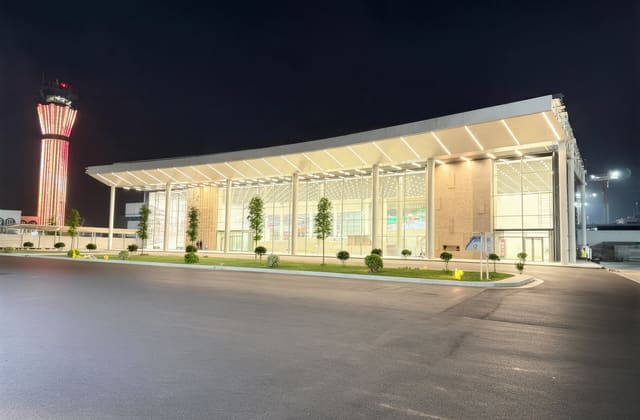
Public building: night facade and canopy
Architectural facade lighting and canopy lighting, filmed in September 2024.
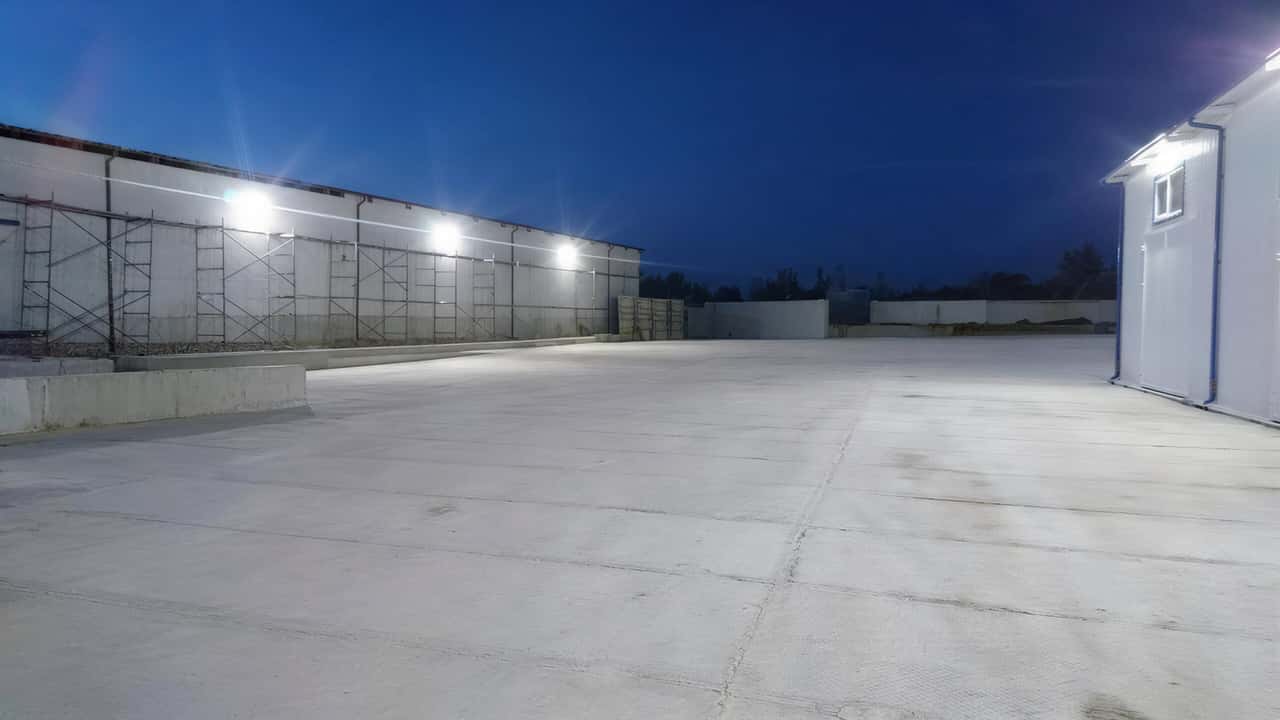
Category B streets and service roads: 0.3-0.8 cd/m² or 4-15 lx under ShNK 2.01.05-24, bracket mounting on a pole, IP65 and operation at +45 °C.
Street lighting is calculated on the carriageway surface. ShNK 2.01.05-24 (table 15) sets the average luminance of an improved surface and, as an alternative, the average horizontal illuminance: category B streets 0.6-1.0 cd/m² or 10-15 lx depending on traffic intensity, category V service roads 0.3-0.4 cd/m² or 4-6 lx; factory forecourts 10 lx (table 16). Uniformity: Lmin/Lmax at least 0.4 (clause 93), and for open areas Emax/Eavg at most 3:1 (clause 105): what matters is the minimum between the columns, not the maximum under one. Two numbers decide it: the column height and the spacing.
The second condition is the climate: Tashkent reached +44.3 °C on 19 July 2026, and during the dust storm of May 2025 PM10 reached 1,585 µg/m³ against a limit of 500. The housing goes well past +70 °C in the sun, and whether the flux survives to the third summer depends on how heat leaves it.
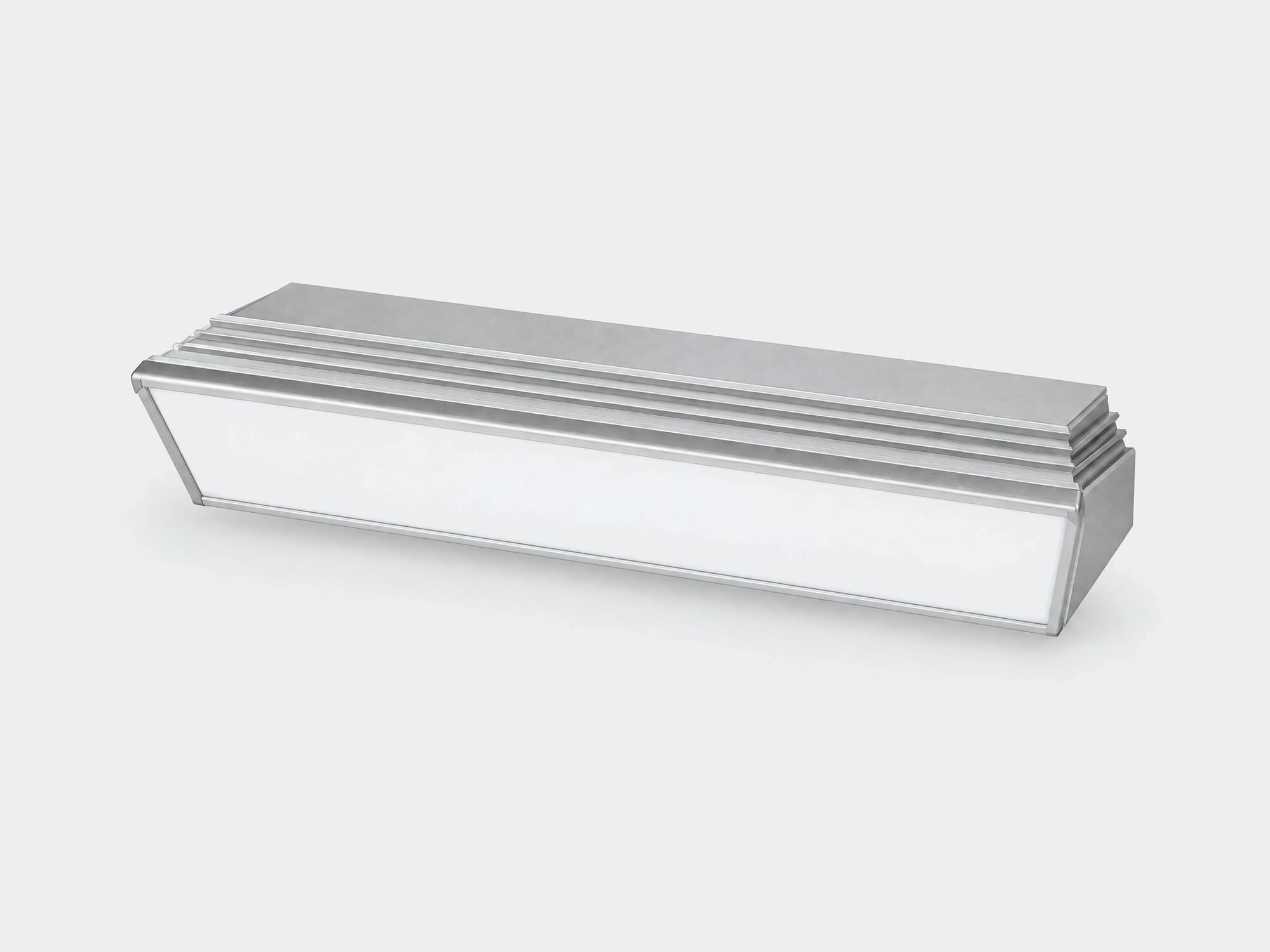
Classic is mounted on a bracket, IP65, installed at 4 to 10 m. The extruded aluminium housing works as the heat sink.
Three colour temperatures: 3000 K for residential streets, 4000 K for site roads, 6500 K where the surface needs contrast.
An internal site road of ≈ 800 m, 7 m wide, 8 m columns, category V:
The Classic 100W flux is 13,000 lm per the header of the 2018 IES file; the file itself does not agree with its own curve (explained on the model page), so the figure is a calculated one. Flux-per-span method: E = F × UF × MF / (spacing × width) with UF 0.35 (the share of flux landing on the carriageway) and MF 0.63 (app. 1, table 3, streets; safety factor 1.6, MF = 1/1.6): 13,000 × 0.35 × 0.63 / (30 × 7) ≈ 14 lx, above the 6 lx for category V and the 10 lx for a category B street with up to 500 vehicles/h. The spacing changes with the road width and the surface class.
Before: the same road on 27 mercury-vapour 250 W lamps at 280 W with ballast, ≈ 7.6 kW. At the nominal flux of new lamps (14,300 lm, Lisma) ≈ 15 lx, and ≈ 10 lx at the end of lamp life (LLMF 0.70).
After: ≈ 2.7 kW at ≈ 14 lx with no end-of-life drop. At 11 burning hours for 365 days a year the difference is ≈ 19,500 kWh a year; in UZS, by the tariff on the date of the calculation (see the savings calculator).
A calculated estimate under the stated assumptions, not guaranteed until measured on site. Figures marked ≈ are estimates.
| Space or zone | Target, lx | Plane and note |
|---|---|---|
| Category B streets, 500 to 2,000 vehicles/h | 0.6 to 0.8 cd/m² or 10 to 15 lx | average luminance of an improved surface; table 15 |
| Category V service roads | 0.3 to 0.4 cd/m² or 4 to 6 lx | table 15; 4 lx on intermediate surfaces, 2 lx on low-grade ones, clause 84 |
| Factory forecourts, non-traffic parts of category A and B squares | 10 | average horizontal on the surface; table 16, item 1 |
| Pedestrian streets | 4 to 6 | 6 in public centres, 4 elsewhere; table 16, item 2 |
Values per ShNK 2.01.05-24 “Natural and artificial lighting” (Ministry of Construction order No. 1/2-68 of 26 September 2024, Ministry of Justice registration No. 309 of 25 October 2024, text at lex.uz/ru/docs/7218587), checked against the text on 17 September 2026; the clause and table are given in every row. H is the horizontal plane at the stated height above the floor, V is vertical. The design target is set by your technical specifications, and we run the DIALux calculation against it.
The catalogue has the full specification table, prices in UZS and the IES files.
Tashkent hit +44.3 °C on 19 July 2026, and during the dust storm of May 2025 PM10 reached 1,585 µg/m³ against a limit of 500. The aluminium housing works as the heat sink: how much light is left by the third summer depends on it.
Send a floor plan or your technical specifications: we return a DIALux calculation, a bill of materials and a payback period. Free of charge.